
Last updated July 11, 2026
Garage Door Repair Maintenance Checklist for Wichita Homeowners
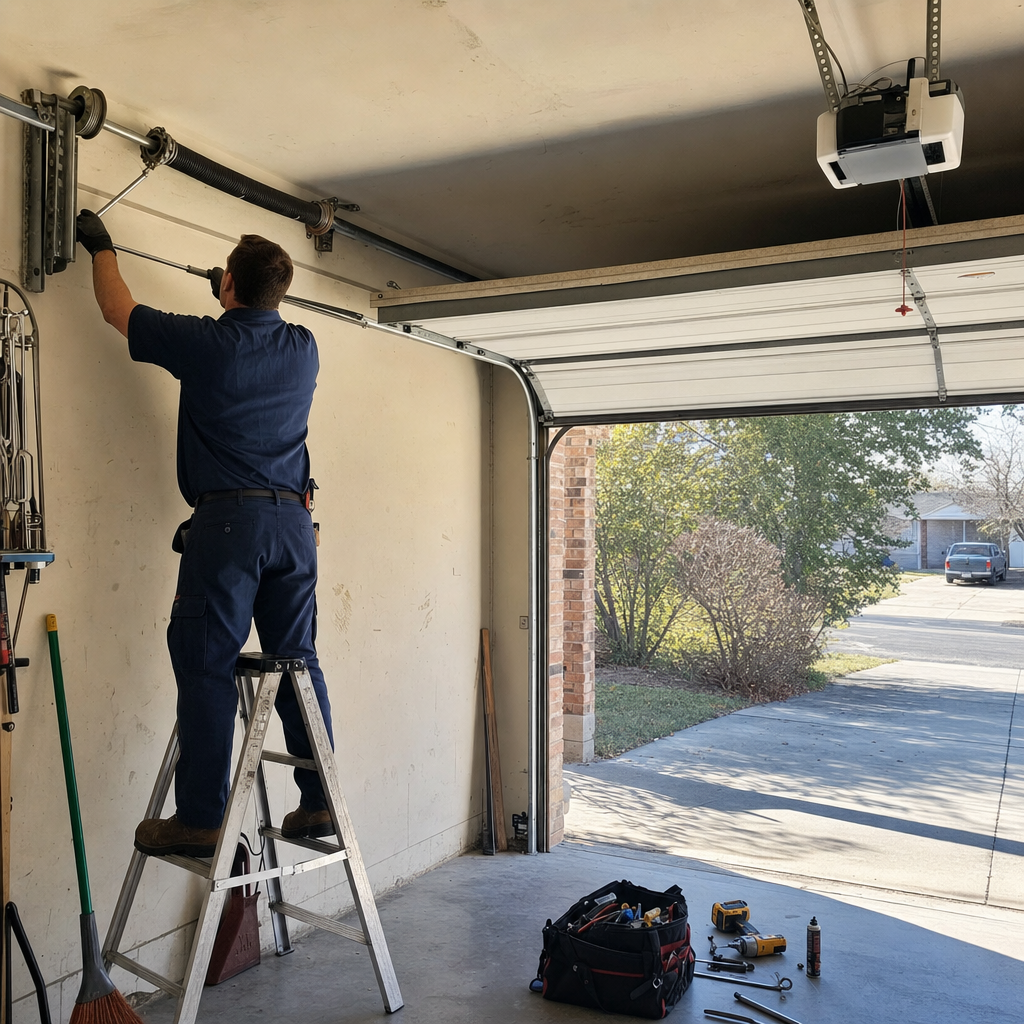
The number one thing that turns a $15 lubrication job into a $400 repair is skipping the 8-minute visual check that would have caught it three months earlier. After 14 years of opening garage doors across Wichita — from Riverside’s historic bungalows to the new builds in Maize — we’ve learned that most catastrophic failures announce themselves early, but only if you know what to listen for and where to look. This guide is written the way we’d hand it to you standing in your own garage: specific, sensory, and split into monthly, semi-annual, and annual tasks so you’re not overwhelmed or under-maintaining. You’ll learn what grinding sounds mean versus squealing versus popping on startup, which lubricant holds up through Kansas summers, and the one DIY diagnostic that immediately tells you if your springs are failing.
Quick Answer
Wichita homeowners should perform monthly visual and auditory checks, semi-annual lubrication and hardware tightening, and annual balance and safety reversal tests. Proper maintenance prevents the spring failures and opener strain that account for roughly 70% of emergency calls we receive during Kansas temperature swings. The full checklist below breaks down exactly what to look for, what to touch, and what to leave alone.
Table of Contents
- Monthly Checks: What to Look and Listen For
- Semi-Annual Maintenance: Lubrication and Hardware
- Annual Tests: Balance, Force, and Safety Reversal
- How Kansas Climate Affects Your Garage Door
- What Voids Your Warranty (and What’s Safe to DIY)
- Common Mistakes to Avoid
- When to Call a Professional
- Frequently Asked Questions
Monthly Checks: What to Look and Listen For
These eight-minute inspections catch problems while they’re still cheap. We recommend the first Saturday of each month — before you’ve loaded the car, when the door is cold and hasn’t been cycled yet.
Step-by-Step Monthly Inspection
- Disconnect the opener. Pull the red release cord and operate the door by hand. It should glide smoothly and stay put at any height. If it drifts down, your springs are losing tension — schedule service before the opener burns out compensating.
- Listen during the first cycle. Stand inside the garage with the door closed. Press the wall button and listen:
- Grinding — metal on metal, usually worn rollers or a failing opener gear in LiftMaster or Chamberlain chain-drive units
- Squealing — dry rollers or hinges begging for lubricant
- Popping on startup — the classic sound of a torsion spring with a fatigued coil, common in Wichita after winter temperature drops
- Rattling that wasn’t there last month — loose hardware, often track bolts or opener rail supports
- Inspect the springs. Look for a gap between coils on torsion springs (mounted above the door), rust flakes, or a slight unwinding at the anchor points. Extension springs (along the horizontal tracks) should show no stretched coils or frayed safety cables. Do not touch springs. Torsion springs store lethal energy — a 16×7 door spring holds roughly 10,000 pounds of torque.
- Check cables for fraying. Look for broken strands, rust spots, or flattening where they wrap around drums. Frayed cables fail without warning and drop the door hard.
- Examine rollers and hinges. Steel rollers should spin freely; nylon rollers should show no cracks. Hinges shouldn’t wobble or show elongated bolt holes.
- Test the weather seal. Close the door and look for daylight underneath. In Wichita’s dry summers, rubber seals harden and shrink faster than national maintenance guides assume — we’ve replaced seals on 3-year-old doors that looked 10 years old.
In Delano and the College Hill area, we see more rodent damage to bottom seals than you’d expect. If the seal has chew marks or gaps, replace it before winter — mice follow the warm air leak straight inside.
Semi-Annual Maintenance: Lubrication and Hardware
Every April and October — after the worst of winter and before summer heat — spend 45 minutes on these tasks. The timing matters: April clears winter corrosion, and October prepares seals and hardware for freeze-thaw cycles.
Lubricant Selection for Kansas Conditions
Skip WD-40 for garage doors — it’s a solvent, not a lubricant, and attracts dust that turns into grinding paste. Use a lithium-based grease or silicone spray rated for -35°F to 250°F. In Wichita, where July highs hit 95°F and January lows dip to 10°F, temperature range matters.
Apply lubricant to these points only:
- Hinges: At pivot points, not the roller stem — one quick shot per hinge
- Roller bearings: Steel rollers only; nylon rollers are self-lubricating and can degrade with grease
- Torsion spring: Light coat across the coils to prevent rust — this is safe to lubricate, not to adjust
- Lock mechanism: If you still use the manual lock
- Opener rail: For chain drives, lubricate the chain; for screw drives, the threaded rod; belt drives need no lubrication
Never lubricate the track. The rollers need friction to roll, not slide. Oiled tracks collect grit and cause the door to slip and bind.
Hardware Tightening Sequence
- Check all track bolts — the lag screws into the wall and the bolts connecting track sections
- Tighten opener rail mounting brackets; vibration loosens these over time
- Inspect and snug roller bracket bolts on the door itself — but do not overtighten; stripped holes in a Clopay or Amarr steel door are expensive to fix
- Verify the opener’s emergency release cord hangs 6 feet from the floor, as required for safety
After tightening, run the door through two full cycles and listen. New rattles mean you found the problem; new grinding means you may have overtightened a bearing point.
Annual Tests: Balance, Force, and Safety Reversal
These three tests reveal problems that monthly checks miss. Perform them every January — the post-holiday lull is perfect, and you’ll catch winter damage early.
Test 1: The Balance Test (The One DIY Diagnostic That Matters Most)
This tells you if your torsion springs have lost tension — the leading cause of premature opener failure.
- Close the door and disconnect the opener (red cord)
- Lift the door manually to waist height and release it
- Properly balanced: The door stays within 6 inches of where you left it
- Too heavy (drifts down): Springs have lost tension; the opener is doing extra work and will fail early
- Too light (rises on its own): Springs are over-tensioned; dangerous and hard on cables
In our experience across Wichita, roughly 40% of doors over 7 years old fail this test. Homeowners don’t notice because the opener compensates — until the opener burns out and they’re facing a $400–$700 dual replacement.
Test 2: Force Setting Test
With the opener reconnected, place a 2×4 flat on the ground where the door closes. The door should reverse on contact. If it doesn’t, or if it crushes the board, the force setting is too high — a safety hazard for children and pets. Adjust per your opener manual; Genie and Chamberlain units have different adjustment procedures.
Test 3: Safety Reversal Test
Wave a broomstick through the photo-eye beam while the door is closing. It should reverse immediately. Clean the lenses with a soft cloth — Wichita’s dust and pollen coat them fast. If alignment is off (one LED blinking), realign by hand; this is safe homeowner maintenance.
How Kansas Climate Affects Your Garage Door
National maintenance guides assume moderate humidity and stable temperatures. Wichita doesn’t cooperate.
Summer: Our dry heat — July averages 93°F with humidity dropping below 40% — degrades rubber seals and vinyl weatherstripping faster than in humid climates. We’ve pulled hardened, cracked seals off doors in Bel Aire that looked fine from the outside but leaked air badly. Check seals monthly in summer, not just annually.
Winter: Freeze-thaw cycles between December and March swell and contract door frames, especially on older homes in Riverside and Midtown with wooden jambs. Track alignment shifts subtly; what rolled smoothly in October may bind in February. The popping sound on startup? Often a torsion spring that contracted overnight and is struggling to overcome the initial load.
Spring storms: Hail dents steel doors and cracks windows; wind-driven debris damages top sections. After any severe weather, run your monthly check immediately — we’ve seen doors that worked fine post-storm but had cracked hinges that failed a week later.
Garage temperature swings: Uninsulated Wichita garages see 40°F+ daily swings. Metal components expand and contract; lubricant migrates; opener electronics stress. If your garage isn’t climate-controlled, step up to monthly lubrication checks and consider a garage door with polyurethane insulation — we install Clopay and Amarr insulated models that stabilize interior temperatures significantly.
What Voids Your Warranty (and What’s Safe to DIY)
Most manufacturer warranties — including LiftMaster, Chamberlain, Genie, Clopay, and Amarr — cover defects in materials and workmanship, not damage from improper maintenance. Here’s the line between safe homeowner work and warranty-voiding mistakes.
Safe for Homeowners (Warranty Preserved)
- Lubricating hinges, rollers, and springs (not adjusting)
- Tightening visible track and opener hardware
- Cleaning photo-eye lenses and realigning by hand
- Replacing remote batteries and programming remotes
- Replacing weather seal (bottom and sides)
- Testing balance, force, and safety reversal
Voids Warranty — Call a Professional
- Adjusting or replacing torsion springs: This is the big one. Every major brand voids the door warranty if homeowner-adjusted springs cause section damage. More importantly, it’s genuinely dangerous — we’ve treated the aftermath of DIY spring releases, and it’s not worth the risk.
- Removing door sections or track brackets: Misalignment stresses the entire system and voids structural warranties
- Modifying opener force limits beyond factory specs: If a door is binding and you crank the opener force to compensate, you’re masking a mechanical problem and voiding opener coverage
- Using non-specified lubricants on opener chains or belts: Some manufacturers specify proprietary lubricants; others reject claims where petroleum-based grease degraded plastic components
When in doubt, photograph the component and call. At Monarch Garage Door Service Kansas home, we’ll tell you over the phone whether it’s safe to handle yourself.
Common Mistakes to Avoid
- Using WD-40 as a lubricant. It’s a water displacer and solvent. It strips existing grease, attracts dust, and turns into abrasive sludge within two months. We’ve replaced entire roller sets in Wichita homes where WD-40 was the only “maintenance” performed.
- Ignoring the door and only maintaining the opener. The opener is the weak link in a well-maintained door, and the overworked hero in a neglected one. If your opener fails every 3–4 years, your door is probably out of balance.
- Lubricating the track. Rollers need to roll, not slide. Oiled tracks collect Kansas dust and cause the door to slip, jerk, and eventually jump the track — especially on windy days in open areas like Goddard and Andover.
- Skipping the disconnect test. Homeowners with automatic openers rarely pull the red cord. If you can’t lift your door manually, you’re one opener failure away from being trapped inside or locked out.
- Waiting for the spring to break. A torsion spring doesn’t fail suddenly without warning — the gap between coils grows, the door feels heavier, and the opener strains. Replace at the first signs of fatigue, not after it snaps at 6 AM on a Monday.
- Using the wrong seal for the floor. Wichita’s expansive clay soils shift concrete slabs seasonally. A rigid vinyl seal won’t conform; a flexible rubber bulb seal adapts better. Match the seal to your floor condition, not just the door brand.
When to Call a Professional
Call when you encounter anything involving stored energy, structural alignment, or electrical diagnostics beyond battery replacement. Specifically: torsion spring adjustment or replacement, cable replacement (even if only one is frayed — they wear in pairs), track realignment after impact, opener internal gear repair, and any door that fails the balance test.
Monarch Garage Door Service Kansas offers free estimates in Wichita — call (866) 428-5950. Aaron Bennett handles the inspection personally, so the person who diagnoses the problem is the same one who fixes it. No subcontractor handoffs, no upsell scripts. Garage Door Repair in Kansas City and Garage Door Installation in Kansas City are also available through our extended service area.
Frequently Asked Questions
Monthly visual and auditory checks, semi-annual lubrication and hardware tightening, and annual balance and safety tests. Kansas temperature extremes make this schedule more critical than in milder climates — we see twice the spring failure rate during February and July compared to shoulder months.
A lithium-based grease or silicone spray rated from -35°F to 250°F. Avoid WD-40 and petroleum-based products that thin out above 100°F and attract dust. Apply sparingly to hinges, steel roller bearings, torsion springs, and opener chains — never to tracks or nylon rollers.
A professional tune-up typically runs $120–$180 and includes balance adjustment, hardware tightening, lubrication, safety tests, and a written condition report. Call (866) 428-5950 for an exact quote — estimates are free, and we’ll tell you honestly if your door doesn’t need service yet.
No. Torsion springs store lethal energy — a standard 16-foot door spring holds approximately 10,000 pounds of torque. Winding bar slippage causes serious injury or death annually. This is not a DIY task; it’s also the single fastest way to void your door warranty. The balance test is safe to perform; spring adjustment is not.
Popping on startup usually indicates a torsion spring with fatigued coils binding against each other before releasing. In Wichita, this worsens after cold nights when metal contracts. It’s an early warning of spring failure — schedule inspection within two weeks, not months.
Most major brands — including LiftMaster, Chamberlain, and Genie — require professional installation for full warranty coverage. DIY installation typically limits coverage to parts only, excluding labor and consequential damage. For opener service and installation, see our Garage Door Opener in Kansas City page.
The Bottom Line
The $15 lithium grease and 8-minute monthly check prevent the $400 spring-and-opener failures that dominate our emergency calls. Split your maintenance by frequency — monthly for eyes and ears, semi-annual for hands-on work, annual for diagnostic tests — and respect the danger line: lubricate freely, but never adjust springs or cables yourself. In Wichita’s climate, the maintenance that works in Seattle or Atlanta falls short; our dry summers and freeze-thaw winters demand more frequent seal inspection and temperature-rated lubricants. Keep this checklist posted in your garage, check off tasks as you complete them, and call when something feels off rather than after it fails.
Written by Aaron Bennett, Owner & Lead Technician at Monarch Garage Door Service Kansas, serving Wichita since 2012.