
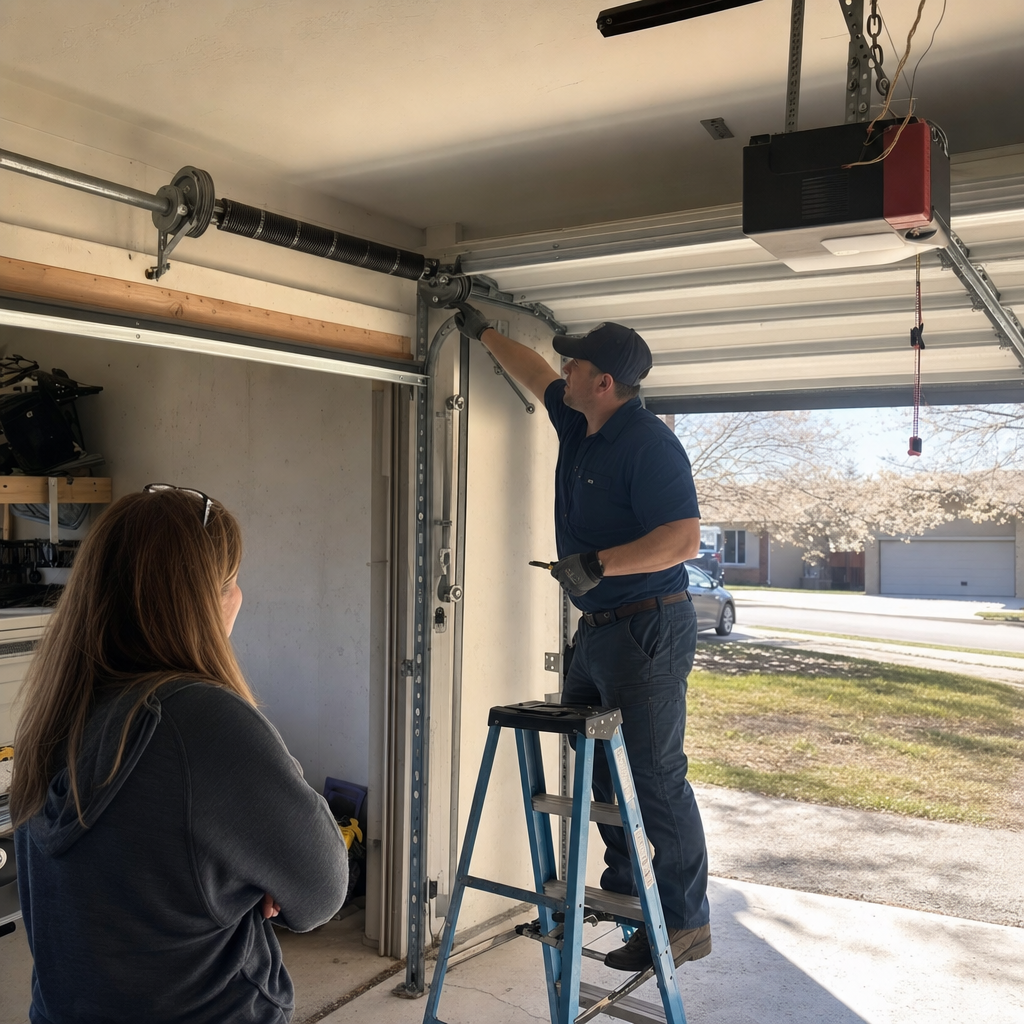
Why Does My Garage Door Reverse in Kansas, KS? Three Systems, Three Different Fixes
A garage door that reverses before hitting the ground is almost always protecting itself from what it thinks is an obstacle — the real question is which of three systems is sending that false signal. In most Kansas homes we service, the culprit is either misaligned safety sensors, a travel limit switch that’s drifted out of calibration, or a force setting that’s too sensitive for seasonal track changes. Figuring out which one is lying to your opener saves you from throwing parts at the wrong problem — and from the frustration of a door that worked fine yesterday. If you’d rather skip the detective work, we diagnose these issues same-day across Kansas; call (866) 428-5950 and we’ll sort it out.
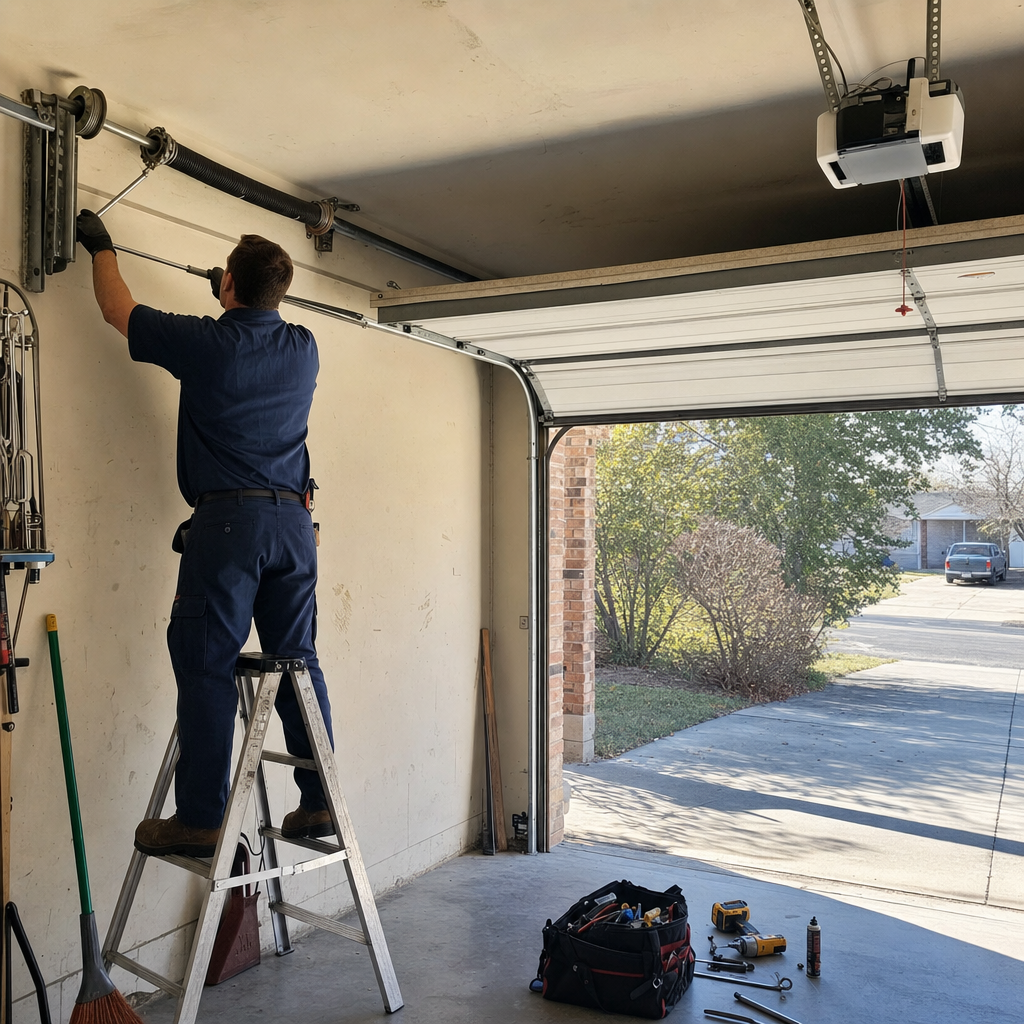
Your Door Isn’t Broken — It’s Confused by One of Three Signals
Most troubleshooting guides lump every reversal into the same bucket: “check your sensors.” That’s not wrong, but it’s not precise enough to actually fix your door. After fourteen years of walking into Kansas homes with this exact complaint, we’ve learned to read the reversal pattern like a mechanic reads an engine noise. The symptom tells you which system to investigate first.
Here’s the distinction most guides miss:
- Reverses before touching the ground — Travel limit problem. The opener thinks the floor is higher than it actually is.
- Reverses immediately on contact with the floor — Force limit problem or physical obstruction. The opener meets resistance it didn’t expect.
- Reverses mid-travel, sometimes randomly — Safety sensor interruption or wiring fault. Something is breaking the invisible beam between the two eyes.
Each of these has a completely different fix. Treating them interchangeably is how homeowners end up adjusting sensors for two hours when the real issue is a limit switch that needs two minutes with a screwdriver.
The Kansas Seasonal Factor: When Your Door “Breaks” in November and “Fixes Itself” in April
Here’s something the national troubleshooting articles never mention: Kansas temperature swings shift your door’s behavior in predictable ways. When November cold snaps hit and metal tracks contract slightly, the door’s travel distance changes by fractions of an inch — enough to confuse the travel limit switch on older openers, especially Craftsman and Genie units from the early 2010s that we see constantly in the Armourdale and Argentine neighborhoods.
We get a wave of these calls every first cold snap. The homeowner swears the door worked fine last week. It did — until thermal contraction told the opener the floor arrived early. If your reversal appeared with the first freeze and disappears by spring, you’re not imagining things. That’s a travel limit calibration, not a sensor replacement, and it’s a ten-minute adjustment if you know which potentiometer to turn.
How to Diagnose Each Reversal Pattern
Safety Sensors: The LiftMaster and Chamberlain Alignment Test
LiftMaster and Chamberlain dominate Kansas residential installs — probably three in four openers we touch in this market. Their safety sensor diagnostic is straightforward if you know what the lights mean, and most homeowners don’t because the manual got thrown out in 2017.
Here’s the actual signal pattern:
- Sending eye — Should blink steadily. This tells you it’s transmitting.
- Receiving eye — Should show solid green. This tells you the beam is uninterrupted and aligned.
- Amber or blinking on either eye — Alignment is off, or something’s blocking the path.
The two-screw adjustment method: loosen the wing nut or Phillips screw on the bracket (varies by model year), pivot the eye until the receiving light holds solid green, then retighten. Don’t overtighten — these brackets strip easily, especially on units that have been bumped by lawn equipment in Kansas garages where storage space runs tight.
If both lights look correct and the door still reverses mid-travel, you’ve got an intermittent wiring short — often where the low-voltage line staples into the wall near the opener head, or where it passes through a pinch point near the rail. That’s past where most homeowners should dig; voltage testing on logic board circuits isn’t a guess-and-check situation.
Travel Limits: When the Opener Thinks the Floor Moved
Travel limits tell the opener how far down is “down.” When they drift — from vibration, age, or that thermal contraction we mentioned — the opener hits its programmed floor position while the door is still inches in the air. It interprets this as hitting an obstacle and reverses.
On most Genie and Craftsman chain-drive units common in Kansas’s older housing stock, the limit adjustment is a pair of white plastic screws on the opener head, marked with arrows for “up” and “down.” A quarter-turn on the down-limit screw extends travel. The critical detail: adjust in small increments — eighth-turns, not full rotations — and test with a 2×4 on the floor to confirm the door actually reverses on contact as required by federal safety standards.
We see homeowners crank these screws two full turns, get the door to close, and then wonder why it slams into the concrete a month later. Incremental adjustment. Always.
Force Limits: The Setting Homeowners Can Touch (Carefully)
Force limits control how much resistance the opener accepts before deciding it’s hit something. Too sensitive, and a slightly sticky roller or a bit of debris in the track triggers reversal. Too loose, and the door won’t reverse when it should — which is a genuine safety hazard, especially with kids or pets around.
On Genie and Craftsman units, the force adjustment is typically a dial or screw near the limit controls, marked with numbers or “more/less” indicators. Here’s the specific procedure we recommend for homeowners:
- Run the door fully open, then fully closed, observing for binding or rough spots.
- If reversal happens on contact with the floor, increase down-force by one click or increment.
- Test with the 2×4 obstruction — door must reverse on contact.
- If it takes more than three increments to stop the false reversal, stop adjusting and call a technician. The spring balance is likely off, or there’s mechanical binding that force adjustment is masking, not fixing.
That last point matters. We’ve replaced springs on Kansas doors where the previous “fix” was cranking force limits to compensate for a broken spring half. The opener eventually burns out its gear set from overwork, turning a $160–$305 spring repair into a $225–$495 opener replacement. “Straight answers, real repairs” means telling you when adjustment is a band-aid, not a cure.
When DIY Ends: The Problems That Need Aaron Bennett’s Bench
There’s a boundary past which homeowner troubleshooting becomes expensive guessing. If your sensors are aligned, your limits are calibrated, your force is properly set, and the door still reverses intermittently — you’ve entered logic board or wiring diagnostic territory.
Intermittent reversal is the most misdiagnosed garage door problem in Kansas. It could be a failing relay on the circuit board, a temperature-sensitive solder joint, a staple through low-voltage wiring that only shorts when humidity spikes, or a motor capacitor dropping voltage under load. These aren’t visible problems. They require sequential voltage testing, load testing under actual door weight, and brand-specific knowledge of which board revisions had which factory defects.
That’s where fourteen years of focused garage door work matters. We’ve seen the failure patterns on eight major brands — LiftMaster, Chamberlain, Genie, Clopay, Amarr, Wayne Dalton, Craftsman, and Raynor — and we carry the diagnostic equipment to isolate electrical faults without replacing every component until something sticks. “Your brand, our expertise” isn’t a slogan; it’s the difference between a $110–$290 opener repair and an unnecessary full replacement.
Aaron Bennett grew up in the Armourdale neighborhood of Kansas, KS, and has spent his entire working life within a few miles of where he was raised. He picked up the mechanical side of things at Kansas City Kansas Community College, where he focused on technical trades before finding his footing in garage door installation and repair — work that suited his preference for solving a real problem with his hands and leaving the job done right the same day. He’s been running Monarch Garage Door Service for over 14 years now, and in that time he’s built a reputation for honest diagnostics and not upselling parts a customer doesn’t actually need. His oldest kid started riding along on weekend calls a few years back, which Aaron says is either a sign the trade has a future or proof he needs better boundaries — probably both.
If I wouldn’t put it on my own door, I’m not putting it on yours.
What Reversal Repairs Actually Cost in Kansas
Most reversal issues fall into straightforward diagnostic and adjustment categories, but when parts are needed, Kansas homeowners deserve actual numbers, not “call for pricing” games. Here’s what we charge for the repairs most commonly tied to persistent reversal problems:
| Service | Price Range in Kansas |
|---|---|
| Sensor realignment / wiring repair | $110–$215 |
| Travel limit / force adjustment (diagnostic included) | $135–$195 |
| Spring repair (when force limits masked failure) | $160–$305 |
| Opener repair (logic board, capacitor, gear set) | $110–$290 |
| Opener replacement (if board failure is catastrophic) | $225–$495 |
| Full garage door repair range | $135–$540 |
We don’t charge separately for diagnosis when you proceed with repair — the assessment is built into the job. Estimates are free, and we’ll tell you if the fix is something you can handle yourself before we roll a truck. That’s the owner-operator difference: Aaron Bennett answers for the advice, not just the invoice.
Common Local Scenarios: What We Actually See in Kansas Homes
The Argentine Bungalow with the 1998 Craftsman
These openers are workhorses, but their plastic limit gears crystallize after fifteen Kansas summers in uninsulated garages. The door reverses six inches from the floor in October, works fine by Memorial Day, and the homeowner replaces sensors twice before calling us. It’s never the sensors. It’s a $135 limit gear replacement that takes forty minutes.
The Turner New Build with LiftMaster MyQ
Smart openers add complexity. We’ve seen WiFi module firmware conflicts cause random mid-travel reversals that look exactly like sensor failures. The sensors test perfect, the limits are dead-on, and the door still reverses at 2 PM on Tuesdays because the cloud sync hiccupped. Factory resets fix some; others need a logic board flash we can perform on-site.
The Rosedale Rental with the “Handyman Special”
Previous owner installed a Genie screw-drive unit with the rail pitched wrong for the header height. Door binds at the bend point, opener thinks it’s an obstacle, reverses. Three handymen adjusted sensors. We rehang the opener on proper angle iron and the problem vanishes. Sometimes the hardware is fine and the installation is the defect.
FAQs
Your travel limit switch is programmed to stop at a floor position that’s higher than your actual floor — usually from calibration drift, vibration, or seasonal track contraction in cold weather. Adjust the down-travel limit screw on your opener head in small increments until the door fully closes, then test with a 2×4 obstruction to confirm safety reversal still works. If you’re not comfortable working on an overhead unit with stored spring tension, call (866) 428-5950 for a same-day adjustment in Kansas — estimates are free.
Your safety sensors are either misaligned, have a wiring fault, or are receiving intermittent interference from LED bulbs or garage lighting on the same circuit. Check that your receiving eye shows solid green; if it’s blinking or amber, realign the bracket until it holds steady. If both lights appear correct and the problem persists, you likely have a wiring short or failing logic board that requires professional diagnosis. Call (866) 428-5950 — we’ll trace the circuit properly rather than guessing.
Repair is almost always cheaper if the motor and rail assembly are sound — opener repair runs $110–$290 versus $225–$495 for replacement. We only recommend replacement when the logic board has catastrophic failure, the motor shows winding damage, or the unit is so obsolete that parts are unavailable. Our 139 verified reviews at 4.7 stars include plenty of customers we talked out of replacement when repair was the honest call.
Yes — we carry sensors, limit switches, capacitors, and gear sets for all eight major brands on every service vehicle, and most reversal diagnostics resolve in a single visit. Emergency garage door service is available when a stuck-open door creates a security or weather exposure issue. Call (866) 428-5950 and we’ll give you a realistic arrival window, not a four-hour black hole.
When to Call Monarch Garage Door Service Kansas
If you’ve checked your sensor lights, verified nothing’s blocking the door path, and the reversal still doesn’t match a clear pattern — it’s time to stop adjusting and start diagnosing. Fourteen years of focused garage door work means we’ve seen the obscure failures too: the Raynor board that only faults above 80°F, the Wayne Dalton torqueMaster spring that binds just enough to confuse force settings, the Chamberlain WiFi module that randomizes travel commands.
We serve Kansas, KS with the owner on every job — Aaron Bennett shows up, assesses, and stands behind the repair. No subcontractor roulette, no upsell script, no “we’ll send someone Tuesday” when your car is trapped in the garage tonight.
If you’d rather have it looked at, Monarch Garage Door Service Kansas offers a no-pressure assessment in Kansas — call (866) 428-5950.
Written by Aaron Bennett, Owner & Lead Technician at Monarch Garage Door Service Kansas, serving Kansas, KS.